

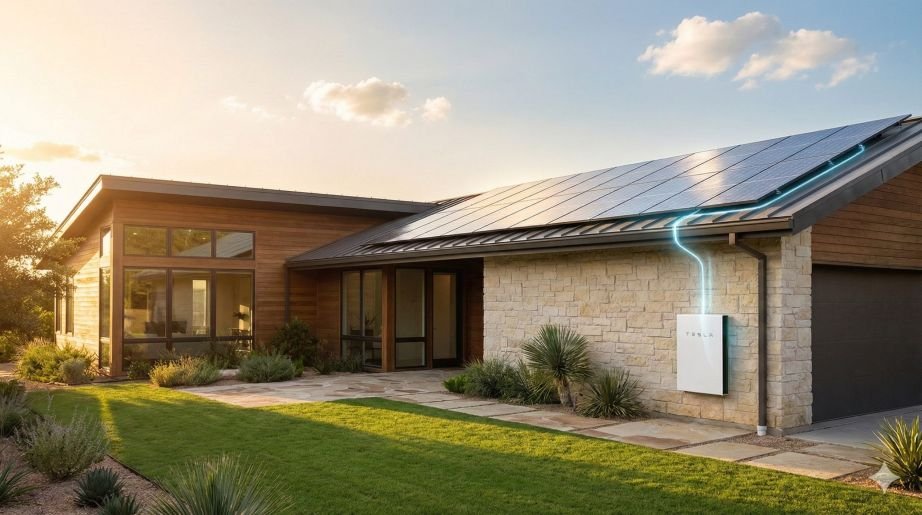
Solar Batteries and Storage Systems in Thailand: A Complete Guide to Managing Excess Solar Power
TL;DR – As Thailand transitions to a green energy future, managing excess solar power with advanced solar batteries and storage systems is the key to true energy independence. By capturing surplus daytime energy, homeowners and businesses can slash electricity bills, secure reliable backup power during blackouts, and maximize their renewable investment. Whether using lithium-ion technology or hybrid inverters, modern photovoltaic (PV) storage solutions are making sustainable living more affordable and reliable across the Kingdom.
Solar panels are only half the story. Once you’ve got them on your roof and you’re watching the numbers tick over on a sunny afternoon, it doesn’t take long before a question comes up: what’s actually happening to all that electricity when nobody’s home to use it? If you don’t have storage, the short answer is that most of it goes to waste. That’s a problem worth fixing.
Solar battery storage in Thailand has moved on considerably in the past few years. The technology is more reliable, the prices have come down, and there are now systems well-suited to everything from a Bangkok townhouse to a remote villa in the hills outside Chiang Mai. This article covers how these systems work, what the technology choices mean in practice, how the numbers stack up financially, and answers the questions we hear most often from homeowners and businesses across Thailand.
The Midday Surplus Problem: Why Storing Excess Solar Power Matters
Thailand gets a lot of sun. Peak solar generation typically runs from around 10:00 AM to 3:00 PM, and during those hours a standard 5 kW or 10 kW residential photovoltaic (PV) system will often produce far more electricity than the household is actually using, especially if everyone’s out at work or school.
That surplus energy has to go somewhere. Without a battery, it usually ends up being exported back to the grid under Thailand’s net-accounting schemes, run by the Metropolitan Electricity Authority (MEA) or Provincial Electricity Authority (PEA). The catch is that the buy-back rate you receive is well below the retail price you pay for grid electricity. You’re selling low and buying back high later that evening. That’s not a great deal.
Keeping your own solar power in a battery and using it yourself is almost always more profitable than sending it back to the grid for a fraction of what it cost you.
The answer is a Battery Energy Storage System, commonly abbreviated to BESS. By holding that midday surplus in a battery bank, you turn what would have been wasted overproduction into usable electricity for the evening hours. In the energy industry this is called load shifting, and it’s the most reliable way to get your electricity bill down in a country with Thailand’s solar resources and tariff structure.
How Solar Battery Storage Systems Actually Work
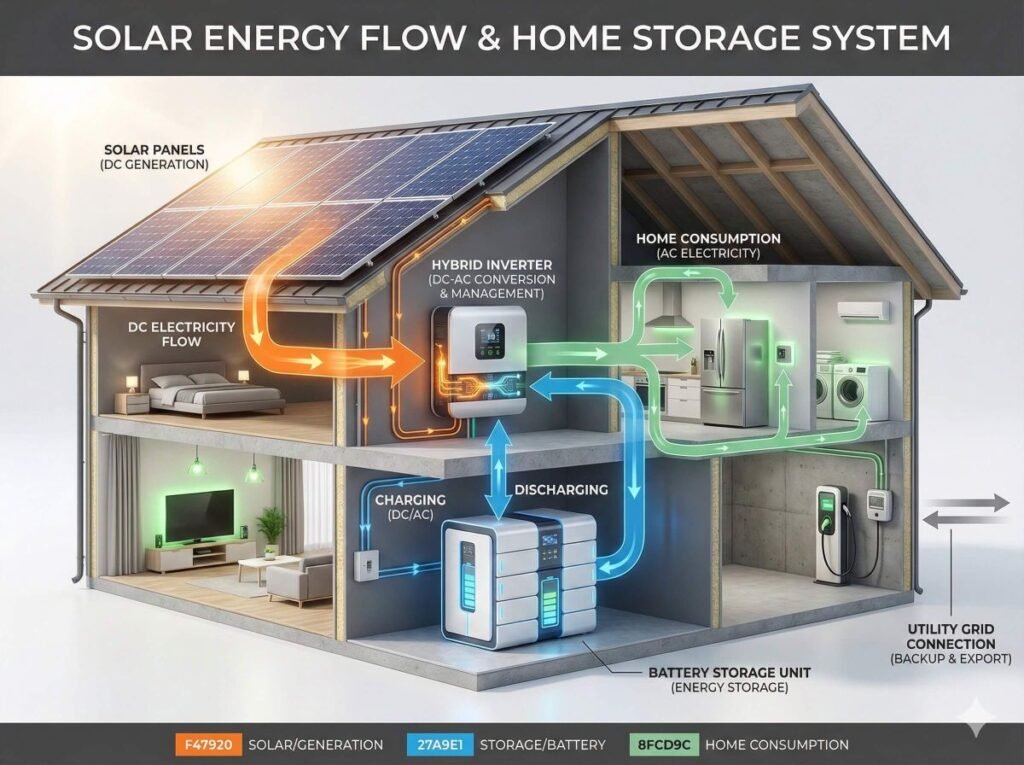
A solar storage setup isn’t just a battery on a wall. There are three main components that all need to work together properly, and understanding what each one does helps you ask the right questions when you’re getting quotes.
The Hybrid Solar Inverter
The inverter is the most important single piece of the system. A standard grid-tied inverter does one thing: it converts the direct current (DC) electricity your panels produce into alternating current (AC) that your appliances can use. That’s it.
However the advantages of a hybrid solar system means the inverter does considerably more. It manages power coming in from the panels, power flowing into or out of the battery bank, and the connection to the utility grid, all at the same time. When your panels are generating more than the house needs, the hybrid inverter pushes the excess into the battery automatically. When the battery is full and production still outpaces demand, it can throttle output or export the remainder. After dark, when stored power starts running low, it switches over to the grid without any action from you. That changeover happens in under 20 milliseconds, which is fast enough that your computer, TV, and home appliances won’t register it at all.
Lithium Iron Phosphate (LFP) Batteries: Why the Chemistry Matters in Thailand
Battery chemistry is probably the most consequential choice you’ll make when speccing a solar storage system in Thailand, and the climate is the reason why. Two main technologies are widely available: Lithium Iron Phosphate (LFP, also written as LiFePO4) and older lead-acid units. Standard Lithium-ion NMC cells sit somewhere between the two.
For Thailand specifically, LFP is what most experienced installers will recommend, and here’s why:
- Heat tolerance. Thailand’s ambient temperatures are high, and battery enclosures can get considerably hotter than the outside air. LFP chemistry handles elevated temperatures far better than NMC or lead-acid alternatives. The risk of thermal runaway, which is an overheating cascade that can lead to fire, is much lower with LFP. In a Thai installation, that’s not a minor footnote. It’s a genuine safety consideration.
- Depth of Discharge (DoD). LFP batteries can typically be drawn down to 80 to 90 percent of their total capacity without harming the cells. What that means in practice: a 10 kWh LFP battery gives you roughly 8.5 to 9 kWh of usable storage.
- Cycle life. One cycle is one full charge and discharge. Quality LFP cells are rated for 3,000 to 6,000 or more cycles, which works out to 10 to 15 years of daily use before capacity degrades noticeably. Lead-acid batteries typically offer a fraction of that.
- Maintenance. LFP units are sealed and need no routine upkeep once installed. Flooded lead-acid batteries, by contrast, need periodic top-ups of distilled water and careful ventilation.
Lead-acid batteries do have a lower purchase price, but when you account for their shorter lifespan, higher maintenance requirements, lower efficiency, and poorer performance in heat, they tend to cost more over a ten-year period than a quality LFP system bought upfront.
The Smart Energy Management System (EMS)
The better systems on the market now include an EMS, a software layer that does more than simply charge the battery when there’s surplus and discharge it when there isn’t. A good EMS looks at weather forecasts and your historical usage patterns and uses that data to make smarter decisions. If it expects a cloudy afternoon, it’ll hold onto more of the morning’s surplus rather than drawing it down early. If it knows your evenings are heavy on consumption, it makes sure the battery is full before the sun goes down. It’s not magic, but over the course of a year it adds up to meaningfully better performance.
Comparative Analysis of Solar Battery Technologies for the Thai Climate
This table evaluates the most common energy storage solutions based on performance, durability, and cost-effectiveness in high-temperature environments.
|
Performance Metric |
Lithium Iron Phosphate (LiFePO4 / LFP) |
Lithium-Ion (NMC) |
Lead-Acid (Deep Cycle / GEL) |
|
Best Use Case |
High-performance home storage |
Portable power & lightweight apps |
Budget-entry or tiny systems |
|
Round-Trip Efficiency |
95% – 98% (Minimal loss) |
92% – 96% |
70% – 85% (High loss) |
|
Cycle Life (Lifespan) |
6,000+ Cycles (15+ Years) |
2,000 – 3,000 Cycles |
500 – 1,000 Cycles |
|
Depth of Discharge (DoD) |
Up to 90% – 100% |
80% – 90% |
Max 50% (To prevent damage) |
|
Thermal Stability |
Exceptional (Safe up to 60°C) |
Moderate (Needs cooling) |
Poor (Degrades fast in heat) |
|
Maintenance Required |
None (Solid-state) |
None |
Periodic checking of levels |
|
Total Cost of Ownership |
Lowest (Best long-term value) |
Moderate |
High (Needs frequent replacement) |
Why Your Location in Thailand Changes What You Need
Thailand isn’t a single environment when it comes to solar storage. A system that’s right for a property in central Bangkok is likely to be spec’d quite differently from one on the Andaman coast or up in a rural northern province. A few factors drive this.
Coastal Properties: Phuket, Samui, Pattaya, Hua Hin
Salt air and moisture are real problems for outdoor electrical equipment in coastal areas. Battery enclosures and inverter housings need to carry appropriate IP (Ingress Protection) ratings and be built from materials that resist corrosion. Skimping on this leads to failures well before the warranty period is up.
Bangkok and the Central Plains
The MEA grid in Bangkok is fairly reliable by Thai standards, so the primary case for solar battery storage here is financial rather than about backup power. The focus is on using stored solar energy during Time-of-Use peak windows to avoid the highest tariff rates. Systems here can be slightly smaller and don’t necessarily need to be sized for extended grid outages.
Rural and Provincial Areas Served by the PEA
Out in the provinces, the picture is different. Tropical storms, flash flooding, and older infrastructure mean grid outages are a regular occurrence in many areas, not an occasional inconvenience. For homes and businesses relying on the PEA grid, a solar battery backup system goes from being a nice cost-saving addition to something that keeps the lights on, the fridge running, and sensitive equipment protected. The sub-20-millisecond changeover time of a quality hybrid inverter means those appliances never know the grid has gone down.
The Numbers: What Solar Battery Storage Actually Costs and Returns
A lot of people look at the upfront cost of a solar battery system and get understandably cautious. That’s fair. But the number that actually matters for decision-making is the Levelised Cost of Storage, or LCOS, which takes the total cost of buying and running the system and divides it by how much energy it delivers over its lifetime. Viewed that way, the case for LFP storage in Thailand looks a lot more favourable than a sticker price comparison suggests.
Time-of-Use Tariffs: The Hidden Advantage
Thailand uses a Time-of-Use (TOU) tariff system. Grid electricity costs more during peak demand periods, typically weekday daytimes and early evenings, and less during off-peak hours late at night. When you use your stored solar power during those expensive peak windows, you’re avoiding the utility’s highest rates. You’re buying your power at the cost of your solar installation, which over the life of the system works out to a very low per-kilowatt-hour figure.
For many Thai households, five to seven years of avoided peak-rate electricity costs will cover the full cost of the panels and storage. As grid electricity prices in Thailand continue rising over time, that payback period keeps getting shorter for future installations.
Self-Consumption: The Metric That Moves the Needle
Self-consumption is the share of your solar production that you actually use yourself, rather than exporting. A solar PV system with no storage typically achieves somewhere between 30 and 40 percent self-consumption for a household where people are out during the day. Add a properly sized battery and that figure can climb above 80 percent. That shift, from 35 percent to 80 percent, is where the financial returns on solar really change.
Are Prices Still Falling?
Yes, and by a meaningful amount. The global cost of LFP battery cells has dropped sharply over the past few years as production has scaled up, particularly in China. That trend is continuing. Combined with available government incentives and the rising cost of grid electricity in Thailand, the payback period for a solar battery system that might once have been 10 to 12 years is now achievable in 5 to 7 years under favourable conditions.
What Else Does Solar Battery Storage Give You?
The electricity bill reduction gets most of the attention, but there are other things worth knowing about:
- Energy independence. Not having to rely entirely on the MEA or PEA grid is valuable in its own right. In a country where weather-related outages are common, having your own stored power gives you a level of control that grid-only households simply don’t have.
- Protecting electronics and appliances. The fast changeover time built into hybrid inverters means that computers, smart home systems, medical devices, and other sensitive equipment stay running without interruption during grid events.
- Lower carbon footprint. Every kilowatt-hour of stored solar energy used in place of grid electricity is power that didn’t come from a fossil fuel plant. For homeowners who care about their environmental impact, the numbers are real.
- Property value. A home with a working solar PV and storage system is increasingly attractive to buyers and tenants, particularly in expat and premium residential markets across Thailand.
- Grid-level benefits. At scale, Battery Energy Storage Systems reduce pressure on the national grid by absorbing excess renewable generation and releasing it during peak demand. Individual systems contribute to that picture in a small but genuine way.
Government Incentives for Solar Battery Storage in Thailand
The Thai government has been pushing the expansion of renewable energy capacity for a number of years, largely through its Alternative Energy Development Plan (AEDP). That push has produced a range of subsidies, tax incentives, and net-accounting programmes that can reduce the cost of going solar.
Subsidies and tax benefits apply to both residential and commercial solar PV installations, and in many cases extend to solar battery storage systems. These programmes do get reviewed and changed, so checking the current status directly with the Board of Investment (BOI), the Energy Regulatory Commission (ERC), or your local MEA or PEA office is worth doing before you commit to a purchase. Any reputable solar installer will have up-to-date knowledge of what’s available and will factor it into their quotes.
The net-accounting programmes run by MEA and PEA allow grid-connected solar owners to export surplus generation and receive a credit against their bill. That said, as covered earlier, the buy-back rates on offer usually make storing that power and using it yourself the better financial choice for most households.
How to Choose the Right Solar Battery System for Your Home or Business
Getting the right system comes down to doing the groundwork before you start looking at products. These are the steps worth taking:
Start with your electricity bills
Pull together twelve months of electricity bills and look at your average daily consumption, when your peak usage tends to fall, and whether there’s much seasonal variation. Your installer needs this information to size the system accurately. Guessing at it leads to systems that are either too small to be useful or more expensive than they need to be.
Check what you already have
If there’s already a PV solar system with either monocrystalline or polycrystalline solar panels on the property, find out whether the current inverter is hybrid-capable. If it isn’t, you have two choices: replace it with a hybrid unit (known as DC coupling), or add an AC-coupled battery that works alongside the existing inverter without replacing it. Both approaches work; an installer can tell you which makes more sense for your setup.
Work out how much battery capacity you actually need
Battery capacity is measured in kilowatt-hours (kWh). A simple way to start: if your household typically uses 10 to 15 kWh during the evening and overnight, a battery in the same range will cover most of that. Add a reasonable margin for the days your solar production is lower than expected, and make sure the battery’s power output (measured in kW) is high enough to handle your peak simultaneous appliance loads without tripping.
Insist on LFP chemistry from a brand with local support
For Thailand, LFP is the battery type to go with. Look for brands that back their cells with a genuine cycle-life warranty, typically 3,000 or more cycles, or 10 years from installation, whichever comes first. Local after-sales support matters too. A battery that ships from overseas without any in-country service network is a risk.
Don’t cut corners on installation
A well-specced battery system can still fail early if it’s installed carelessly. Make sure your installer is properly certified, that cabling meets Thai Electrical Code standards, and that the battery is positioned somewhere with adequate ventilation to keep it cool. Poor installation is behind most of the premature failures we hear about
What’s Coming Next: V2H, Smart Grids, and Virtual Power Plants
Solar battery storage in Thailand won’t stay where it is now. A couple of developments on the horizon are worth knowing about when you’re planning a system today.
Vehicle-to-Home (V2H) Technology
As electric vehicles become more common in Thailand, compatible EVs will be able to act as a secondary battery for your home. A car charged on cheap overnight electricity or daytime solar becomes a mobile power reserve that can supply the house during an outage or peak-tariff period. Installing a well-sized battery system and appropriate infrastructure now puts you in a position to add V2H capability when it becomes widely available without having to redo your electrical setup.
Smart Grids and Virtual Power Plants
Thailand is actively working toward Smart Grid infrastructure. Once that matures, homeowners with battery storage may be able to join Virtual Power Plant (VPP) programmes, where thousands of individual home batteries are pooled into a single coordinated resource that sells stored power back to the national grid during periods of high national demand, at premium rates. Your home battery could, in that scenario, earn passive income while also helping to balance the grid. It’s a few years away from being a mainstream reality, but designing your system with that in mind costs nothing extra today.
Final Thoughts: Taking Control of Your Power
The shift toward clean energy storage in Thailand is about more than just being eco-friendly; it is about taking control of a fundamental resource. Excess solar power is a gift from the Thai sun, and letting it go to waste is no longer necessary. With a correctly sized battery bank and a smart hybrid system, you can ensure that every ray of light hitting your roof contributes to your financial freedom and your family’s security.
Pro-Tip: The “20-80 Rule” for Thai Solar Owners: To maximize the lifespan of your LFP battery in Thailand’s heat, try to keep your “State of Charge” (SoC) between 20% and 80%. While these batteries can handle a full discharge, keeping them within this “goldilocks zone” can extend their usable life by up to 30%, ensuring your investment pays off well into the 2030s.
If you are looking to maximize your home’s potential or want a professional assessment of your current solar production, we are here to help. At Solar Panels Thailand, we specialize in high-performance storage solutions tailored to the local environment.
Contact us today at +66 82 704 6939 or visit our Contact us Page to begin your journey toward total energy independence.
Key Takeaways for Your Energy Strategy
- Self-Consumption is Priority: In Thailand, it is more profitable to store and use your excess power than to sell it back to the grid at low feed-in-tariff rates.
- LFP is the Choice for Safety: Lithium Iron Phosphate is the recommended chemistry for tropical climates due to its high thermal stability and long cycle life.
- Load Shifting Saves Money: Using stored energy during the utility’s peak “Time-of-Use” hours provides the fastest return on investment.
- Energy Resilience: Solar batteries provide a seamless backup, protecting your home against the frequent grid instability caused by Thailand’s tropical weather patterns.
- Future-Ready Infrastructure: Installing a battery system now prepares your home for upcoming technologies like V2H (Vehicle-to-Home) and Smart Grid participation.
FAQs
A solar battery storage system, also called a Battery Energy Storage System or BESS, is a rechargeable battery bank connected to your solar panels via a hybrid inverter. When your panels produce more electricity than you’re using at that moment, the surplus is automatically diverted into the battery rather than being exported to the grid at low rates. You can then draw on that stored power in the evening, overnight, or when the grid goes down.
Thailand has high solar output, a Time-of-Use tariff system that makes peak-period grid electricity expensive, and grid reliability that varies quite a bit depending on where you are. Storage lets you use more of the solar power you generate yourself, avoid the highest-cost grid periods, and keep the lights on when the grid fails. All three of those factors are more pronounced in Thailand than in many other countries.
Load shifting means using energy at a different time from when it was generated. In practice: you charge your battery from your solar panels during the day, then use that stored power during the early evening when grid electricity is at its most expensive. You’re avoiding the utility’s peak rate and using power that, from a cost-per-kilowatt-hour standpoint, costs you next to nothing. That gap between your solar storage cost and the peak grid rate is where the savings come from.
Lithium Iron Phosphate, known as LFP or LiFePO4, is what most Thailand-experienced installers will point you toward, and for good reason. It handles high ambient temperatures without the safety risks associated with other lithium chemistries, it can be discharged to 80 to 90 percent of its capacity without shortening its life, and it’s rated for 3,000 to 6,000 or more charge cycles. Standard NMC lithium-ion and lead-acid batteries are less suited to Thailand’s heat and don’t offer comparable longevity.
Yes, if the system uses a hybrid inverter with islanding and backup capability. When the grid drops, the inverter automatically switches the house to battery power. The changeover happens in under 20 milliseconds, which your appliances and electronics won’t notice. The battery keeps supplying power until it runs out or the grid comes back. On a sunny day, your panels will also be topping the battery back up, which can extend the backup period considerably.
Depth of Discharge (DoD) is the share of a battery’s total capacity that can safely be used in one cycle. A battery with 90 percent DoD gives you 9 kWh of usable storage from a 10 kWh unit. Higher DoD means more usable energy from the same size battery, and it’s generally a sign of better cell quality. LFP batteries tend to have higher DoD ratings than lead-acid equivalents.
Cycle life is the number of full charge and discharge cycles a battery can complete before its storage capacity drops to around 80 percent of the original figure. A battery rated at 4,000 cycles, used once per day, would hit the end of its warranty life after about 11 years. LFP batteries consistently offer higher cycle life ratings than lead-acid or NMC alternatives at similar price points, which is one of the reasons they tend to be better value over a ten-year horizon.
If you’re starting from scratch, yes, you need a hybrid solar inverter rather than a standard grid-tied one. If you’ve already got a solar system with a standard inverter, you have two routes: swap the inverter out for a hybrid model (DC coupling), or add an AC-coupled battery system that works alongside your existing inverter without replacing it. Which option makes more sense for your situation depends on your current hardware, and a qualified installer can tell you quickly which way to go.
In most cases, yes. AC-coupled battery systems are designed specifically for retrofitting onto existing solar PV installations, and they don’t require the original inverter to be replaced. That said, compatibility does depend on your existing inverter model and age. Before buying anything, get a professional to look at your current setup and confirm which battery options will actually work with it.
ontent
It depends on your consumption, system size, and local tariff rates, but the uplift from adding storage to an existing solar system is usually significant. A household solar system without storage typically achieves 30 to 40 percent self-consumption. Add a well-sized battery and that can rise to 75 to 85 percent. Combined with using stored power during peak TOU periods, many users see monthly bill reductions in the range of 50 to 80 percent. Over the 10 to 15 year lifespan of an LFP battery, cumulative savings typically more than cover the installation cost.
There are various subsidies, tax incentives, and net-accounting schemes in place to support solar adoption. These programmes are periodically revised, so the best approach is to check current provisions with the Board of Investment (BOI), the Energy Regulatory Commission (ERC), or your local MEA or PEA office before committing. A reputable solar installer will have current knowledge of what’s on offer and will work it into their quotes.
Modern LFP battery systems are low-maintenance by design. The battery unit itself is sealed and needs nothing from you day-to-day. The full system should get a professional inspection every 12 to 24 months to check connections, make sure software and firmware are current, clean any ventilation filters, and confirm the monitoring is working correctly. Outside of that, your main job is keeping an eye on performance through the mobile app.
A hybrid system stays connected to the utility grid and uses the battery to maximise your use of self-generated solar power and provide backup during outages, drawing from the grid when the battery is depleted. An off-grid solar system is completely disconnected from any utility supply, relying entirely on solar generation and whatever’s in the battery. Off-grid setups require larger battery banks and usually a generator for periods of extended poor weather. They make sense for properties where grid connection isn’t available or is prohibitively expensive to arrange.
Yes, though output on overcast days is lower, typically somewhere between 10 and 30 percent of what you’d see on a clear day depending on cloud cover. That reduced generation still feeds into the battery and helps keep it topped up. For extended periods of poor weather, like a multi-day monsoon event, a hybrid system will pull supplemental power from the grid to cover the gap. An off-grid system has to rely on whatever was stored during the preceding sunny days, which is one of the reasons off-grid systems are sized more conservatively.
Total installed cost varies with battery capacity (kWh), inverter size (kW), installation complexity, and brand selection. As a rough guide, a quality residential system suitable for a mid-sized Thai home runs from around 150,000 to 400,000 Thai Baht or more depending on capacity. LFP cell prices continue to fall, so systems are cheaper now than they were two or three years ago. The most accurate way to get a number is a site survey and written quote from a qualified installer.
Either approach works. Doing panels first lets you start saving immediately and gives you a period of real usage data to inform the battery sizing decision. Doing both at once generally reduces total installation cost by combining the work into a single visit and may avoid having to partially upgrade the inverter later. Talk through both scenarios with your installer, including the cost difference, and decide based on your current budget and timeline.
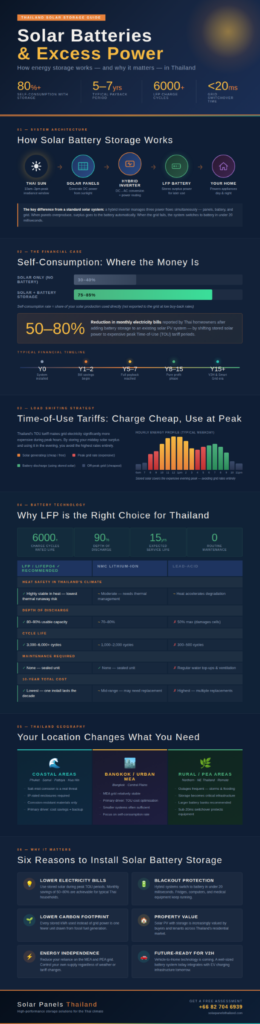
How Solar Batteries Stack up in Thailand the data and Metrics in Visual Form
Want to Talk Through Your Options?
Solar battery storage in Thailand is no longer something only early adopters bother with. The technology has matured, the prices have come down to where the numbers actually work, and the benefits go well beyond what appears on your electricity bill each month.
If you’d like a professional assessment of your property’s solar potential, want to know what a storage system would realistically save you, or just want to talk through what the options look like for your situation, we’re available to help.
Call us: +66 82 704 6939 | Solar Panels Thailand – Contact Us
Solid guide on adding battery to existing solar in Thailand. The financial case for self-consumption solar Thailand really stands out – avoiding low buy-back rates and shifting to off-peak makes payback faster. For anyone in coastal spots like Hua Hin, the geography section nailed the corrosion and heat issues. Definitely leaning toward a hybrid inverter + LFP setup now. Appreciate the no-nonsense stats and tips.
Thanks for the response Dave and agree your making the right choice, just drop us a line if want any more practical advice on your installation we love Hua Hin and be happy to meet up and chat